After the Longest Night: Tarot, Shadow Work, and the First Step Forward
Yule has passed, but the season of return has only just begun.
The longest night has opened the way for the slow return of the light. Not all at once. Not with urgency. Not as a demand to become clear, productive, or transformed by morning. The light returns gradually, and that gradual return has something important to teach us.
Yule is often spoken about as a celebration of the returning sun, and it is. But it is also a threshold between what has ended and what is beginning to take shape. The dark has done its work. It has stripped away noise, slowed the body, and invited us to notice what we have been carrying.
The days after Yule are not empty space. They are part of the ritual.
This is the time when we begin to listen for what the dark revealed. We do not need to rush towards the light or force ourselves into a new version of being. We can move gently, with attention. We can ask what is ready to be released, what still needs care, and what small spark is beginning to return.
This is where tarot can become a powerful practice.
Not as performance. Not as prediction. Not as a way to control what comes next.
Tarot becomes most useful when it is treated as a mirror.
What Yule Teaches After the Longest Night
Yule marks the Winter Solstice, the longest night of the year and the point where the sun begins its slow return. In many earth-based traditions, it is a time of fire, stillness, reflection, and renewal. It reminds us that darkness is not a failure of the light. Darkness is part of the cycle.
This is not always easy to remember.
Many of us have been taught to treat darkness as something to fear, fix, or escape. We are encouraged to move quickly, stay productive, stay positive, and push past discomfort before we have had time to understand what it is showing us.
Yule offers a different rhythm.
It asks us to honour the dark as a place of gestation. A place where old forms decay. A place where seeds rest before they break open. A place where truth can rise because the noise has softened enough for us to hear it.
After Yule, we are not instantly reborn. We are standing at the edge of return. The flame has been relit, but it still needs tending.
This is a powerful time for reflection, especially if you are working with shadow, identity, intuition, or spiritual practice. The question is not only,
What light is returning?
It is also,
What did the dark teach me while I was waiting?
Tarot as a Mirror, Not a Prediction
Tarot is often misunderstood as a tool for telling the future. It can be used for predictive work, but that is only one layer of the practice. At Coven Noctis, tarot is taught as a symbolic language and a mirror for self-inquiry.
A tarot card does not need to tell you what will happen in order to be useful. It can reveal what is already moving beneath the surface. It can bring shape to a pattern you have been living inside. It can give language to a feeling, a wound, a desire, or an inner conflict that has been difficult to name.
This is why tarot is so supportive after Yule.
The season itself asks us to reflect. Tarot gives that reflection structure. Instead of spiralling through vague thoughts, we can place a card on the table and begin a conversation with what is present.
A card might ask:
What am I still carrying from the dark?
What part of me is asking to be heard?
What am I ready to release with care?
What small action helps me tend the returning light?
These questions are not about forcing certainty. They are about deepening relationship with yourself, your intuition, and the unseen patterns shaping your path.
Tarot as Shadow Work
Shadow work is the practice of meeting the parts of ourselves that have been hidden, rejected, exiled, or made unwelcome. These parts are not always dark in the way people imagine. Sometimes the shadow holds anger, grief, envy, fear, or shame. Sometimes it holds tenderness, desire, creativity, intuition, confidence, or joy.
The shadow is not only what we dislike about ourselves. It is also what we have not felt free to claim.
This is where tarot can become deeply valuable.
When used with care, tarot can help us approach the shadow without turning the practice into self-punishment. The cards create enough distance for us to see something clearly without being swallowed by it. They offer image, symbol, archetype, and story. Through that language, we can begin to ask what a part of us is protecting, what it learned, and whether it still needs to lead.
This is important in any trauma-aware practice.
Survival patterns are not failures. They are adaptations. They are ways the body, mind, and spirit learned to continue. A guarded heart, a sharp tongue, a habit of disappearing, a need to control, or a fear of being seen may have protected you once. Now, with steadiness and support, you are allowed to ask whether those patterns still serve the life you are trying to build.
Tarot does not do this work for you. It opens a doorway into the conversation.
You still bring your discernment. You still bring your body. You still bring your willingness to listen.
Cards That Speak to the Season After Yule
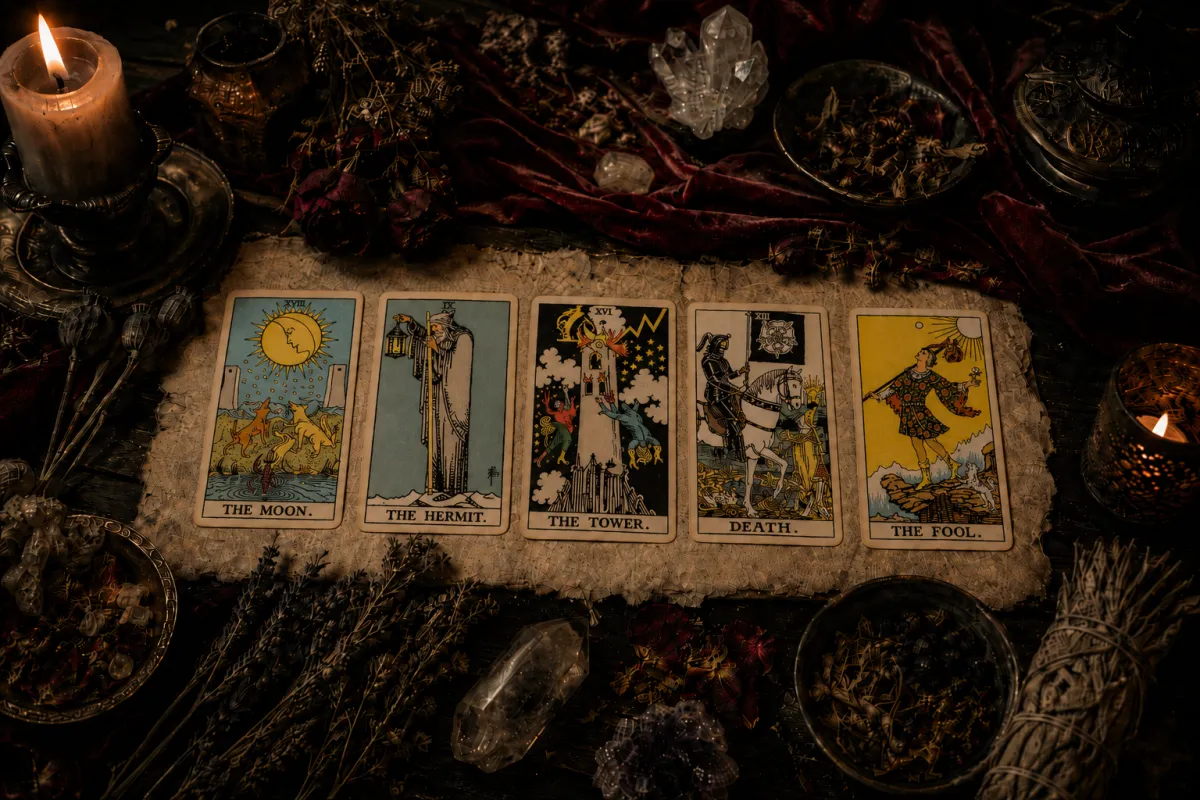
Some tarot cards carry particular weight in the days after Yule because they speak to darkness, transition, return, and the first steps forward.
The Moon often appears when something is not fully clear yet. It can point to fear, illusion, instinct, dreams, and the strange knowing that lives beneath logic. After Yule, The Moon may ask you to honour what you sensed in the dark, even if you do not have language for it yet.
The Hermit teaches the wisdom of withdrawal and inner listening. This is not isolation for the sake of punishment. It is sacred solitude, the kind that allows your own voice to become audible again. The Hermit may ask where you have been looking outside yourself for truth that needs to be found within.
The Tower can be confronting because it speaks to collapse, disruption, and truth breaking through false structures. In shadow work, The Tower often reveals what can no longer hold. After Yule, it may show what the dark has already begun to loosen.
Death is the card of endings, transition, and transformation. It does not usually speak to physical death, but to the necessary release of forms that have completed their cycle. Death reminds us that rebirth requires an ending. The old self cannot always come with us unchanged.
The Fool is the first step after the threshold. The Fool does not begin because everything is certain. They begin because something within them is ready to move. After Yule, The Fool teaches us that beginning again does not need to be dramatic. It can be quiet, honest, and deeply sacred.
Each of these cards can be used as a point of reflection. You do not need to pull them to learn from them. You can place one on your altar, journal with its imagery, or ask what it has to teach you about this season of return.
A Simple Post-Yule Tarot Practice
This practice is designed to be simple and steady. You do not need an elaborate altar or expensive tools. Tools can support the practice. They do not create the witch.
You will need a tarot deck, a journal, and a quiet moment. You may also like to light a candle to honour the returning light.
Before you begin, take a few breaths and let your body arrive. Place one hand over your heart or solar plexus if that feels grounding.
Then shuffle your deck and ask:
What did the dark teach me?
Pull one card. Sit with the imagery before reaching for the guidebook. Notice what your body responds to. Notice what feels familiar, uncomfortable, or quietly true.
Then ask:
What am I ready to release with care?
Pull a second card. Let this card show you what has become heavy, outdated, or no longer aligned with the path you are walking.
Then ask:
What light is beginning to return?
Pull a third card. This does not need to be a grand revelation. Let it show you the small spark, the next thread, or the part of yourself beginning to stir.
Finally, ask:
What is one grounded action I can take to honour this turning?
Pull a fourth card. Let this answer be practical. It may point towards rest, a conversation, a boundary, a ritual, a creative act, or a moment of honesty.
When you are finished, write one present-tense intention inspired by the reading. Keep it simple.
For example:
I am listening to the truth my body has carried.
My energy is returning to me with steadiness and care.
I honour what is ending and tend what is beginning.
Close the practice by thanking your deck, your body, and the returning light.
Reading With Care
Tarot can bring things to the surface, so it is important to approach shadow work with care. If a card opens something tender, you do not need to push through. You can pause. You can breathe. You can put the deck down and come back later.
A grounded practice is not measured by how much intensity you can endure. It is measured by the relationship you build with yourself over time.
If a question feels too sharp, soften it.
Instead of asking,
What is wrong with me?
Try,
What part of me needs more care right now?
Instead of asking,
Why can’t I move on?
Try,
What is still asking to be witnessed?
Instead of asking,
What should I become?
Try,
What part of me is ready to return?
These questions change the tone of the reading. They move the practice away from punishment and towards relationship. That is part of the craft.
The First Step After the Longest Night
The Fool belongs here, in the days after Yule, because The Fool teaches us how to begin without demanding certainty first.
The longest night has passed. The light has started to return. You may still feel tender, tired, unsure, or half-formed. That does not mean you are not ready. It means you are beginning from a real place.
The Fool does not ask you to know the whole path.
The Fool asks whether you are willing to take the first honest step.
If you are feeling called to explore tarot as a deeper practice of reflection, shadow work, and spiritual connection, pre-enrolment is now open for The Fool’s Journey.
You can join the pre-enrolment list HERE.
This course is not about performing certainty or memorising meanings without context. It is about learning tarot as a living conversation with symbol, intuition, shadow, and self-trust.
Let the Light Return Slowly
The season after Yule does not ask you to rush.
It asks you to notice.
Notice what the dark revealed. Notice what feels ready to loosen. Notice what still flickers beneath the surface, even if it is small.
Tarot can help you sit beside that flame. It can help you listen with more structure, more honesty, and more care. It can show you what is ending, what is returning, and what first step is waiting at your feet.
You do not need every answer before you begin.
You only need a quiet moment, a steady breath, and the willingness to turn the first card.
Blessed Yule season.
May the returning light meet you gently.
May your cards speak with honesty.
May your path open with care.