Imbolc as a Threshold: Tending the First Stirring Beneath the Surface
Imbolc does not arrive with the fullness of spring.
It does not ask you to bloom before you have had time to root. It does not demand that the whole path be mapped, the whole dream named, or the next chapter be ready to show to the world.
It arrives quietly.
A small shift in the dark. A softening at the edge of winter. A sense that something beneath the surface has begun to move, even if the outer world still looks unchanged.
In the Southern Hemisphere, Imbolc falls on 1 August, marking the quiet turning point between winter and spring. The land has not fully woken yet, but the first movement has begun. This is not a season of instant action. It is a season of preparation, cleansing, gentle focus, and tending the small sparks that may one day become flame.
In The Grimoire of Days, Imbolc is called The First Stirring. It is described as a sabbat of preparation rather than action, a time for gentle focus, cleansing, and nurturing what is still forming beneath the surface. It reminds us that beginnings do not need to be loud to be powerful, and that what is nurtured in stillness grows strong in time.
That is the heart of Imbolc.
Not performance. Not pressure. Not forcing yourself to become the fullest version of who you are before the season has even turned.
Imbolc is the threshold where we begin to ask:
What is quietly returning?
What is ready to be tended?
What small flame am I willing to protect before it becomes visible to anyone else?
The Threshold Between Winter and Spring
Every sabbat carries a threshold, but Imbolc is one of the gentlest.
It stands between the inwardness of winter and the visible growth of spring. It does not ask us to harvest. It does not ask us to be in full bloom. It does not even ask us to know exactly what the next season will bring.
Instead, Imbolc invites us to notice the first stirring.
The idea that keeps returning. The desire that has not disappeared. The part of your practice that wants attention again. The dream that is still small, but no longer silent. The boundary you know needs strengthening. The ritual you are ready to return to. The version of yourself that has been waiting beneath the quiet.
A threshold is not the destination. It is the place where something becomes possible.
Imbolc reminds us that possibility does not always look dramatic from the outside. Sometimes it looks like clearing a small space on your altar, lighting one candle at dusk, or admitting that you are ready for something to change, even if you do not yet know how that change will unfold.
This is not passive waiting. It is preparation.
It is the sacred work of making yourself available to what is beginning.
Returning Light Does Not Mean Instant Clarity
When we speak about the return of the light, it can be tempting to imagine sudden revelation.
Everything becomes clear. The fog lifts. The path opens. The next step arrives fully formed.
But light often returns slowly.
It arrives in layers. It shows you one corner of the room before it shows you the whole house. It helps you see what needs clearing, what needs tending, what needs releasing, and what is still too tender to touch with force.
This is part of why Imbolc can feel both hopeful and uncomfortable.
Something is moving, but not everything is ready.
You may feel the desire to begin again while still carrying the exhaustion of winter in your body. You may feel inspired, but not yet resourced. You may know what you want to grow, but not yet know what shape it will take.
That does not mean you are behind.
It means you are standing at the beginning of a seasonal threshold.
Imbolc does not demand certainty. It asks for devotion.
Not devotion as pressure. Not devotion as perfection. Devotion as the willingness to tend what has weight before it becomes impressive. Devotion as returning to the flame, even when it is small. Devotion as choosing one honest step instead of trying to force an entire path open at once.
Preparation Is Sacred Work
Modern life often rewards what can be seen.
The launch. The announcement. The finished product. The visible transformation. The proof that something has changed.
But the craft knows that what happens beneath the surface carries power.
Seeds do not look impressive while they are still under soil. A candle does not become a bonfire the moment it is lit. A spell does not become stronger because it is rushed. A practice does not become embodied because it is performed loudly.
Preparation is where we begin to create the conditions for growth.
At Imbolc, preparation might look like cleansing your home or altar, simplifying your routines, clearing space in your journal, preparing your tools, choosing what you are no longer carrying into the next season, or spending time planning without forcing yourself into immediate action.
You might honour Imbolc by cleansing your home or altar with smoke, sound, or intention. You might light a candle at dawn or dusk to honour returning energy, prepare your tools or workspace for the season ahead, plant seeds in preparation for spring, rest while gently refining your intentions, drink warm tea, nourish your nervous system, or allow ideas to form without pressure.
These acts may look small, but small does not mean insignificant.
They are the quiet choices that tell your life:
I am preparing for what wants to grow here.
Tending the Flame
Imbolc is deeply connected to flame.
Not only fire as heat or force, but flame as devotion, hope, inspiration, protection, and careful tending.
A flame needs oxygen. It needs space. It needs attention. If you smother it, it dies. If you ignore it, it can go out. If you try to make it larger before it is ready, it may burn through its fuel too quickly.
Our beginnings are often the same.
The first stirring of change needs protection.
Your new practice, idea, relationship with self, creative project, spiritual commitment, or healing direction may not need to be shared with everyone immediately. It may not need to be explained. It may not need to be proven.
It may simply need tending.
This is especially true if you are reclaiming parts of yourself that have been hidden, dismissed, or buried for a long time. The first spark of return can feel fragile. Not because it is weak, but because it has not yet been given enough steady conditions to grow.
Imbolc asks:
What flame am I tending?
What do I need to stop feeding so this flame can live?
What would help this beginning become sustainable?
What is ready to grow, and what still needs time beneath the surface?
These are not questions to rush through. They are questions to sit with. They are questions to place beside a candle, write into your grimoire, or carry gently through the day.
Choosing What You Are Ready to Grow
Imbolc is not about planting every seed.
It is about choosing what you are ready to nurture.
This is an important distinction.
Not every desire needs your energy right now. Not every idea is ready to become a commitment. Not every doorway needs to be stepped through simply because it has appeared in front of you.
Part of seasonal witchcraft is learning to move with discernment.
What is actually asking for your devotion?
What has been quietly returning, even after months of silence?
What feels aligned, not just exciting?
What would grow stronger if you gave it steady attention instead of sudden intensity?
At Imbolc, we are not forcing the harvest. We are preparing the ground. We are choosing the seed. We are tending the first flame.
That might mean returning to a daily card pull, cleansing your space, beginning a simple morning ritual, writing an intention for the season ahead, preparing your altar for spring, reconnecting with your body, or choosing one area of your life where you are ready to stop abandoning yourself.
It does not need to be dramatic.
It needs to be true.
Imbolc Ritual: Cleansing and Preparation
This ritual is designed to help you honour Imbolc as a threshold of preparation, returning light, and quiet devotion.
Purpose
To cleanse what feels stagnant, honour the returning light, and prepare the ground for what is beginning to stir beneath the surface.
You Will Need
⏾ One white candle
⏾ A bowl of water
⏾ One crystal from the Imbolc correspondences, such as citrine, amethyst, bloodstone, garnet, or turquoise
⏾ A quiet space
⏾ Optional: journal and pen
Step One: Prepare the Space
Place the candle in front of you with the bowl of water beside it.
Place your chosen crystal nearby.
Take three slow breaths, grounding into your body.
Let yourself arrive before you ask anything of the ritual.
Step Two: Light the Candle
Light the white candle as a symbol of returning light.
Look at the flame for a few moments without needing to do anything.
Notice how small the flame is, and how much presence it still carries.
Step Three: Clear and Prepare
Speak aloud or silently:
I clear what no longer serves me.
I prepare the ground for what is to come.
Let the words settle through your body.
You do not need to force a release. You are simply naming that the old weight does not need to lead you into the next season.
Step Four: Touch the Water
Dip your fingers into the water and gently touch your hands, heart, or forehead.
Visualise clarity and calm settling through you.
Say:
I cleanse the old weight from my hands.
I prepare my body for the season ahead.
I honour what is growing slowly.
Step Five: Name the First Stirring
If you are journalling, write:
What is beginning to stir within me?
Let the answer be honest.
It may be a word, a sentence, a desire, a project, a practice, a boundary, or a feeling.
Then write one present-tense intention for the season ahead.
Examples:
My practice is steady, nourishing, and rooted in devotion.
I tend my energy with patience and care.
The right seeds are growing in the right time.
I prepare my life for what is ready to bloom.
My flame is protected as it grows.
Step Six: Close the Ritual
Close by saying:
I tend the spark with patience and care.
Allow the candle to burn fully if it is safe to do so. If not, snuff it gently and return to it later with the same intention.
Dispose of the water outside, in a garden, at the base of a plant, or down the sink with gratitude.
Keep your intention somewhere you will see it throughout the season.
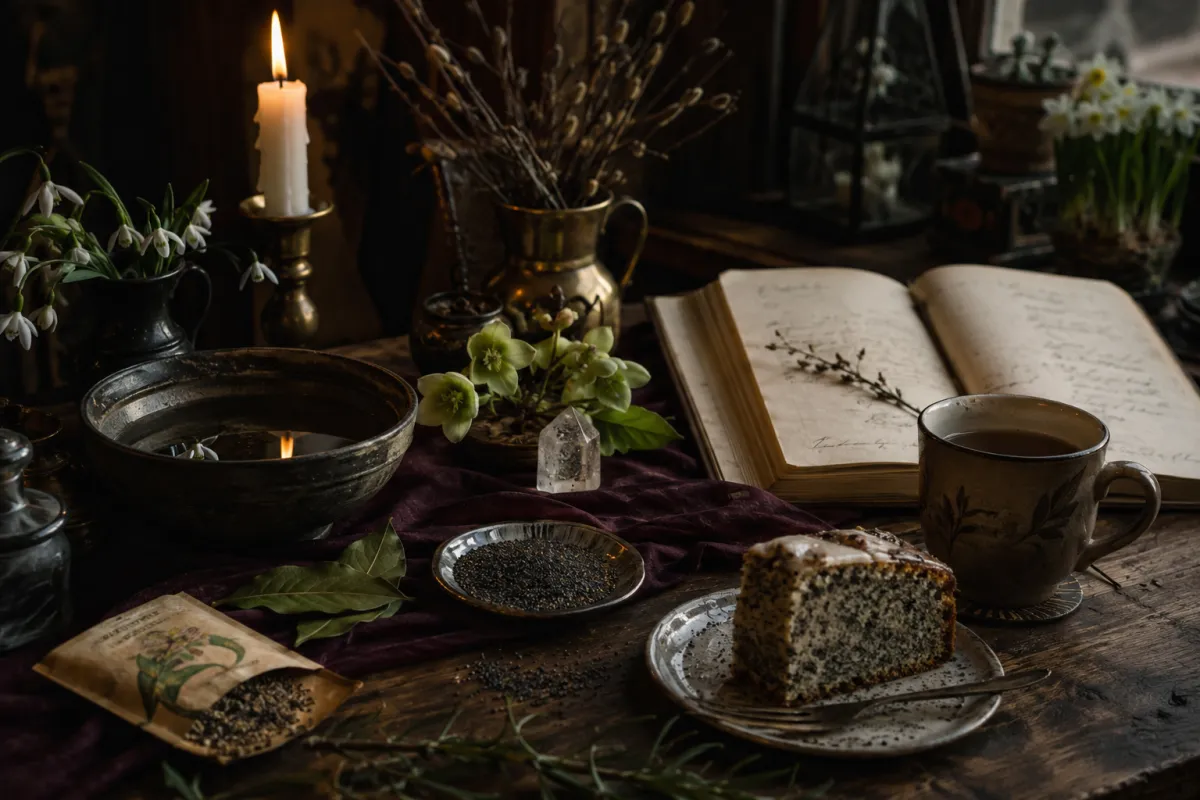
Imbolc Kitchen Practice: Poppy Seed Cake
Food can be a beautiful way to mark Imbolc, especially when you do not have the capacity for a full ritual.
As the cake bakes, focus on one intention you are nurturing beneath the surface. Let the act of baking become part of the practice: warmth, nourishment, patience, and intention made practical.
This is not only baking.
It is a way of bringing seasonal devotion into the body and the home.
Ingredients
⏾ 1½ cups plain flour
⏾ 1½ teaspoons baking powder
⏾ ½ teaspoon salt
⏾ ½ cup poppy seeds
⏾ ¾ cup sugar
⏾ ½ cup milk or plant-based milk
⏾ ⅓ cup neutral oil or melted butter
⏾ 2 eggs
⏾ Zest of 1 lemon, optional
⏾ 1 teaspoon vanilla extract
Method
Preheat your oven to 180°C.
Grease a small round tin or loaf tin.
In one bowl, mix the flour, baking powder, salt, and poppy seeds.
In another bowl, whisk together the sugar, milk, oil or melted butter, eggs, vanilla extract, and lemon zest if you are using it.
Combine the wet and dry ingredients until just mixed.
Pour the batter into the tin and smooth the top.
Bake for 35 to 40 minutes, or until golden and a skewer comes out clean.
Allow the cake to cool slightly before slicing.
As the cake bakes, focus on one intention you are nurturing beneath the surface.
You might place your hand over your heart and say:
From small seeds, great things grow.
I trust the quiet unfolding of my becoming.
Share the cake with others, offer a small piece to the land, or eat it slowly with tea as a simple act of seasonal devotion.
The First Stirring Does Not Need to Be Loud
Imbolc reminds us that beginnings do not need to announce themselves to be real.
The first stirring is often quiet. It may come as a thought that keeps returning, a candle lit at dusk, a drawer cleared, a page opened, a seed planted, or a breath taken with more honesty than yesterday.
This kind of magick can be easy to overlook because it does not always look impressive from the outside. It does not ask for performance. It does not demand that you become fully formed before you have had time to root.
But so much of the craft happens here, in preparation, devotion, and the steady tending of what is not yet visible.
Imbolc asks us to choose what we are ready to grow, and to notice what we are no longer willing to carry into the season ahead. It teaches us to honour the small flame before it becomes a larger fire, and to trust that what begins quietly can still carry power.
As Imbolc arrives, let yourself move gently. Prepare without forcing. Tend the first spark without needing to prove it to anyone else.
Reflect on what is beginning to stir beneath the surface.
That stirring may be the first sign of your next becoming.
Work With the Wheel of the Year
If you would like a grounded way to celebrate the sabbats and bring seasonal magick into your everyday life, The Grimoire of Days was created as a practical companion for the turning year.
Inside, you’ll find seasonal correspondences, simple rituals, everyday practices, recipes, and reflections to help you honour each sabbat without needing to make your practice complicated or performative.
It is not only about marking the big seasonal moments. It is about learning how to live with the rhythm of the year, tend your energy with more intention, and weave small acts of magick into ordinary days.
The Imbolc pages offer cleansing, preparation, gentle intention, and the tending of small sparks, but the full grimoire is designed to guide you through the whole wheel, one season, one threshold, and one sacred return at a time.
May this Imbolc meet you gently.
May the returning light find you.
May what is stirring beneath the surface be tended with patience, devotion, and care.