Why Beginning Witchcraft Can Feel Awkward
There is a particular kind of discomfort that can rise when you first begin practising witchcraft.
It does not mean you are doing it wrong. It does not mean you are not “witchy enough,” and it does not mean the path is closed to you.
Often, it means you are meeting the parts of yourself that were taught to stay hidden.
You might sit down with a candle, a journal, a deck of cards, or a simple intention, and suddenly something in your body tightens. You may feel self-conscious. You may wonder if you are making it all up. You may look at your altar and think everyone else seems to know exactly what they are doing, while you are simply arranging objects and hoping something begins to move.
This is one of the most common experiences at the beginning of the path, but it is rarely spoken about with much honesty.
Many people expect witchcraft to feel powerful straight away. They imagine the moment they light the candle, pull the card, cast the circle, or whisper the spell, something ancient and cinematic will awaken around them.
Sometimes practice does feel like that.
But often, especially at the beginning, it feels unfamiliar. Quiet. Clumsy. Tender. Like learning to speak a language your spirit remembers, but your body has not used in a very long time.
That awkwardness is not a sign of failure.
It may be the first sign of return.
The Awkwardness Is Not the Enemy
When witchcraft feels awkward, it is easy to assume the discomfort means you are not meant for it.
You might think you look ridiculous. You might tell yourself you do not know enough. You may feel as though you should wait until you have better tools, more books, more confidence, or someone else’s permission to begin.
That hesitation often has history behind it.
If you were raised to be practical, quiet, obedient, rational, palatable, or disconnected from your intuition, then witchcraft may not feel natural straight away. Not because it is foreign to you, but because it touches parts of you that may not have been allowed to exist openly.
The part that listens to signs.
The part that trusts instinct.
The part that speaks aloud to fire, water, soil, ancestors, spirit, or self.
The part that believes your inner world carries wisdom.
The part that does not need permission before it knows.
Of course that can feel strange at first.
You are not only learning candles, herbs, tarot, ritual structure, or correspondences. You are learning how to trust yourself again, and that kind of trust is rarely rebuilt in a single moment.
Spiritual Shame and the Fear of Being Seen
For many people, beginning witchcraft touches old spiritual shame.
That shame may come from religion. It may come from family beliefs. It may come from being mocked for being sensitive, intuitive, dramatic, strange, emotional, intense, or interested in things other people dismissed.
You may have learnt to hide your curiosity. You may have learnt to downplay your inner knowing. You may have learnt to call your intuition anxiety, your dreams nonsense, your sensitivity weakness, or your desire for ritual “too much.”
So when you begin to practise, you are not only learning something new. You are moving against old conditioning.
A simple candle spell might bring up the inner voice that says, Who do you think you are?
A tarot reading might bring up the fear of getting it wrong.
Creating an altar might bring up the feeling that you are playing dress-up.
Speaking an intention aloud can feel exposed because your own voice has not always been welcome.
This is why the beginning of witchcraft can feel less like a dramatic awakening and more like a quiet confrontation with every part of you that was taught to shrink.
And still, the work begins there.
In the awkwardness. In the uncertainty. In the first honest act of returning to something that was never truly gone.
Comparison Can Make the Beginning Feel Worse
One of the hardest parts of beginning witchcraft now is that so much of it is visible online.
You see polished altars, perfect grimoires, elaborate rituals, beautiful tools, expensive decks, dried herbs in labelled jars, colour-coordinated spell bottles, and people speaking with complete confidence about practices you are still trying to understand.
There is nothing wrong with beauty. There is nothing wrong with sharing spiritual practice. But if you are at the beginning, online witchcraft can make you feel like everyone else received a secret instruction manual that you somehow missed.
It can make you believe your practice needs to look a certain way before it counts. It can make you feel like your messy notebook is less sacred than someone else’s hand-lettered grimoire. It can make you think your tea light candle, supermarket rosemary, and quiet whispered spell are less powerful than an altar covered in crystals and antique tools.
But witchcraft is not proven by aesthetics.
A beautiful altar can be sacred, and so can a messy kitchen bench. A handwritten petition on scrap paper can hold power. A spell whispered in the car before a hard conversation can hold power. A protection ritual done with nothing but breath, salt, and conviction can hold power.
Tools can support the practice.
They do not create the witch.
The deeper question is not whether your practice looks impressive. The question is whether it is honest, grounded, and connected to your own power.
The Fear of Doing It Wrong
Almost every beginner worries about doing witchcraft wrong.
You may worry about the candle colour, the words, the moon phase, the herbs, the order of the ritual, or whether anything will happen at all. These questions are not silly. They often come from a genuine desire to practise with care, respect, and integrity.
But fear can also become a cage.
If you wait until you know everything before you begin, you will never begin.
Witchcraft is a living practice. You learn through study, but you also learn through doing. Through noticing. Through reflecting. Through trying something simple and paying attention to what shifts.
This does not mean throwing discernment away. It means beginning with grounded, low-risk practices while you build confidence.
You do not need to start with complex spirit work, intense banishing rituals, or elaborate spellcraft. You can begin by cleansing your space, lighting a candle for clarity, pulling one tarot card, grounding your body, writing a petition, or speaking one honest intention.
Small is not weak.
Small is how trust is built.
Feeling Like You Are Playing Dress-Up
This is the part many people do not say aloud.
Sometimes, when you first begin, witchcraft can feel like pretending.
You light the candle and feel silly. You hold the crystal and wonder if you are making it up. You write the spell and feel self-conscious. You call yourself a witch and part of you flinches.
This feeling can be especially strong if you have spent years hiding your spiritual interests, minimising your intuition, or believing that witchcraft belonged to other people. People with more knowledge. People with lineage. People with confidence. People who seem more mystical, more powerful, more certain.
But witchcraft is not a costume you earn the right to wear.
It is not a performance you have to perfect before you are allowed to practise.
It is a relationship.
A relationship with yourself, the earth, energy, intention, cycles, spirit if that is part of your path, and the unseen threads of life that still shape us whether we name them or not.
At first, that relationship may feel unfamiliar. You may not know how to speak within it yet. You may feel clumsy. You may doubt yourself.
That does not mean it is false.
It may mean the relationship is new, or it may mean it is old and has been buried for a long time.
Rebuilding Self-Trust
At the heart of beginning witchcraft is self-trust.
Not blind belief. Not ego. Not deciding that every feeling is a sign and every coincidence is a message.
Real self-trust is quieter than that.
It is the ability to listen inwardly without immediately dismissing yourself. It is the ability to try a ritual and reflect honestly on what happened. It is the ability to say, I am learning, without turning that into shame.
It is the ability to honour your intuition while staying grounded. It is the ability to make your practice personal without needing it to look like anyone else’s.
This kind of trust takes time.
You build it through repetition. You build it by keeping small promises to yourself. You build it by practising when it feels imperfect. You build it by noticing what actually supports you, rather than what simply looks impressive.
You build it when you stop asking, Am I doing this like everyone else? and begin asking, Does this bring me back to my power?
A Simple Spell for Beginning Again
This spell is designed for the awkward beginning.
It is not about becoming instantly confident. It is a small anchor for softening spiritual shame, releasing the fear of getting everything wrong, and giving yourself permission to begin without performance.
Spell: The First Flame of Self-Trust
Purpose
To soften spiritual shame, release the fear of doing witchcraft wrong, and begin rebuilding trust in your own practice.
You Will Need
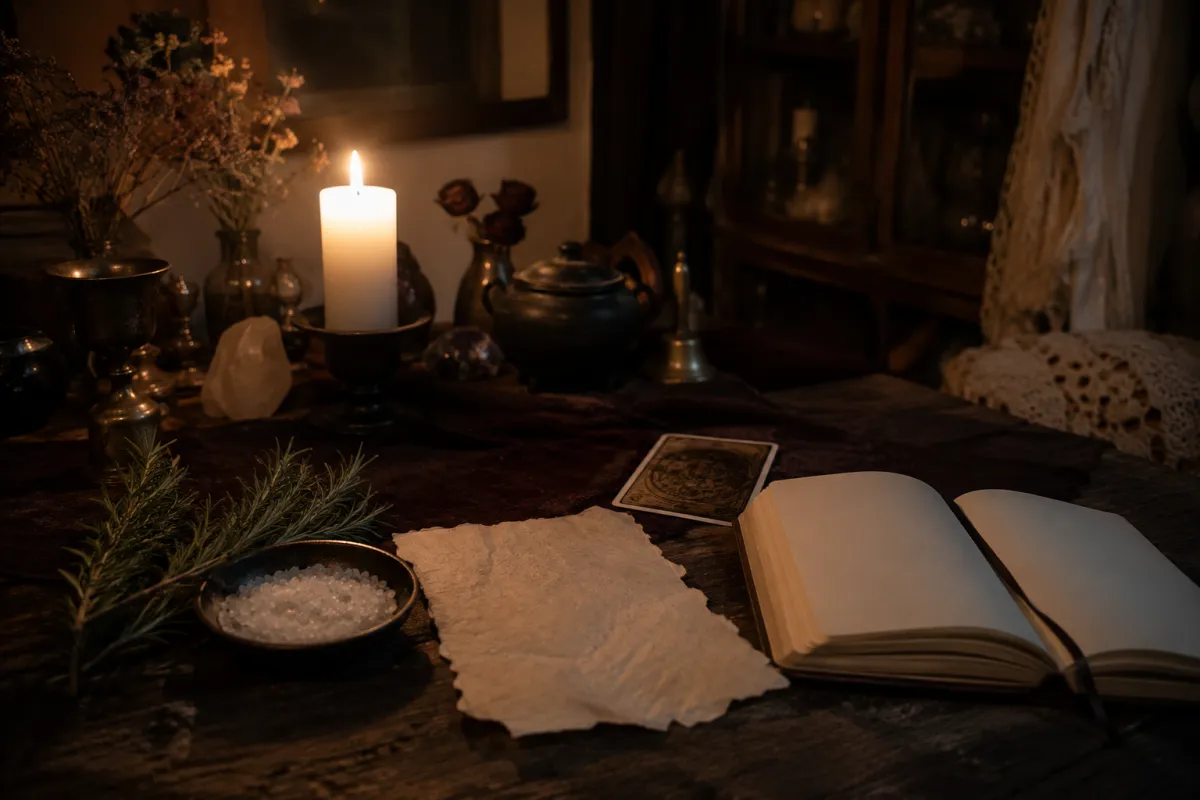
⏾ 1 small white candle
⏾ A pinch of rosemary, dried or fresh
⏾ A small bowl of salt
⏾ A piece of paper
⏾ A pen
⏾ Optional: a tarot or oracle card
⏾ Optional: a small object that represents your practice, such as a key, crystal, charm, shell, feather, or piece of jewellery
Step One: Prepare the Space
Place the candle in front of you, with the bowl of salt and rosemary nearby.
Take three slow breaths.
You do not need to cast a full circle unless you feel called to. You do not need to make the space perfect. You are simply creating a moment of intention.
Say aloud, or quietly within yourself:
I do not need to be perfect to begin.
I do not need to know everything to practise.
I am allowed to return to my magick one honest step at a time.
Step Two: Write the Petition
On the piece of paper, write:
I release the fear of doing this wrong.
I reclaim the right to begin.
My practice grows with me.
Turn the paper clockwise and write your name over the words three times.
Fold the paper toward you to call self-trust back into your body and your practice.
Place it beside the candle at a steady distance from the flame.
Step Three: Light the Candle
Light the candle and say:
With this flame, I begin again.
Not perfectly.
Not performatively.
Honestly.
My magick does not need to impress anyone to be real.
My path is allowed to unfold.
Place the rosemary near the candle, not into the flame, and say:
Rosemary for remembrance.
I remember the parts of me that were never truly lost.
Touch the bowl of salt and say:
Salt for grounding.
I return to myself with protection, clarity, and care.
Step Four: Optional Tarot Pull
If you use tarot or oracle cards, pull one card and ask:
What part of my practice is ready to be reclaimed?
Before reaching for the guidebook, look at the card.
Notice where your eyes go first. Notice the colours, figures, symbols, mood, and feeling. Write down your first impression before checking any meanings.
This is not a test of accuracy. It is an exercise in listening.
Step Five: Close the Spell
When you feel complete, say:
One flame.
One breath.
One honest beginning.
Let the candle burn safely for a little while, or snuff it and return to it later.
Keep the folded petition in your journal, on your altar, or somewhere private. When you feel more steady in your practice, you may bury it, burn it safely, or place it in your grimoire as a marker of where you began.
A Reflection Practice for Your Grimoire
After the spell, write on one or more of these prompts:
⏾ What feels awkward about beginning witchcraft?
⏾ Whose voice do I hear when I worry I am doing it wrong?
⏾ What part of me still wants permission before I practise?
⏾ What does my practice look like when I remove comparison?
⏾ What is one small act of magick I can repeat this week?
⏾ What would change if I trusted myself one percent more?
Let the page be imperfect.
Let it be honest.
That is often where the real work begins.
You Are Allowed to Begin
Beginning witchcraft can feel awkward because it asks you to step out of hiding.
It asks you to use your voice, trust your intuition, and build a relationship with the unseen, the symbolic, the natural, and the deeply personal. It asks you to stop waiting for someone else to tell you that you are allowed.
That can feel uncomfortable.
But discomfort is not always a warning.
Sometimes it is the sensation of a threshold opening. Sometimes it is the first breath after years of holding yourself back. Sometimes it is the beginning of remembering.
You do not need the perfect altar. You do not need to know every herb, moon phase, tarot card, deity, ritual structure, or correspondence. You do not need to perform witchcraft for anyone else.
You only need a grounded first step.
And then another.
And then another.
Step Through The First Gate
If this is the threshold you are standing at, The First Gate was created for you.
It is a guided first step into The Sanctum: Path Reclaimed, created for the ones who feel called to witchcraft but need somewhere grounded, honest, and supportive to begin.
Inside The First Gate, you receive access to Week 1 of Path Reclaimed, including the first lessons, audio teachings, worksheet, practical exercise, quiz, and the Meeting Your Magickal Self meditation.
This is not about fixing yourself.
It is about beginning to reclaim what you were taught to bury.
The First Gate is open when you are ready to step through.